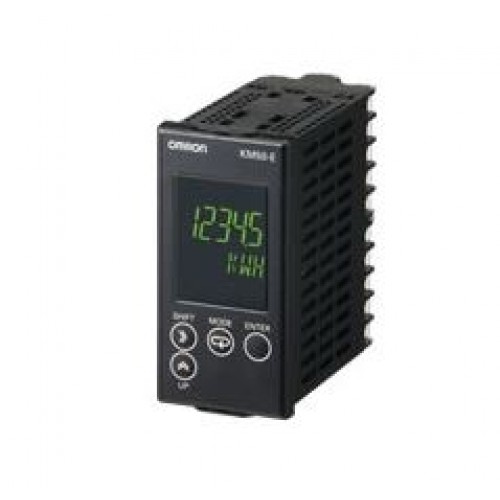
operating power depending on the power usage conditions so that you can see where energy can be saved.
Functions That Support Energy-saving Analysis
Energy Classification (First in the Industry)
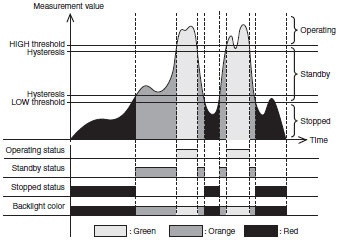
Three-state Energy Classification with three-color displays lets you know where energy can be saved.
operating power depending on the power usage conditions so that you can see where energy can be saved.
status. The criteria can be set as the threshold value of the power, current, or voltage, or as an external input. It is
also possible to change the three color display.
Three-state Energy Classification

Note: This is just an example of setting the threshold values.
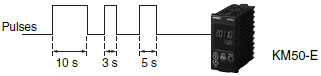
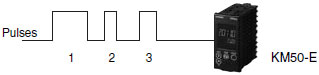
Pulse Measurement and Conversion
To support energy-saving analysis, power consumption can be compared with the flow rate of air, gas, or other
fluids with a single Unit.
The consumption rate of a device can be measured by dividing the power consumption with the measured number of
operations or operation time.
Pulse Input Count Measurement

Pulse Input ON Time Measurement

Simple Temperature Measurement
KM50 Power Monitors have a thermister chip built onto the panel surface for easy measurement of the panel surface temperature.
The temperature display can be offset to match the room temperature to manage trends.
Energy Management with High-precision Measurements
Total Regenerated Energy Measurement
In addition to the consumed energy (total regenerative power consumption), generated power (total regenerative energy) can also be measured.
A single Power Monitor can measure equipment that effectively uses power generated by reverse motor rotation.
Total Reactive Power Measurement
In addition to instantaneous reactive power, the total leading or lagging power consumption can also be measured.
Together with peak power measurements, this function aids with monitoring the power distribution equipment.
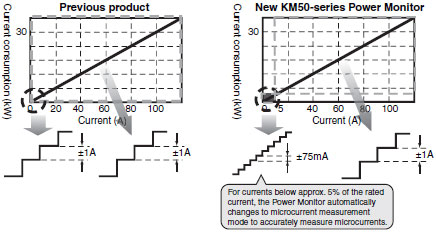
Automatic Range Switching
Automatic range switching enables high-accuracy measurements even for microcurrents.
Standby and stopped power can be accurately measured.
When measured at the distribution board, the total of the distributed values is almost the same as the base measurement.

You can measure microcurrents of ±75 mA with a CT with a rated current of 100 A. (Reference Value)
You can measure microcurrents of ±4 mA with a CT with a rated current of 5 A. (Reference Value)
Note: Reference values are typical values. Actual values may vary.
Inverter Compatibility
Measurements can be made on the primary side of an inverter.
Power consumption can be measured even after installing inverters which are widely used to save energy. This enables you to accurately grasp the effect obtained by introducing the inverter.
Functions That Support Saving Energy
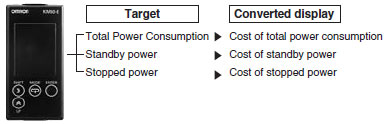
Conversion to Monetary Cost
The total power consumption can be converted to the equivalent monetary cost.
Energy consumption classified as standby and stopped power can also be converted to the cost.
Displaying the cost of the wasted energy can be used to support energy-saving measures.

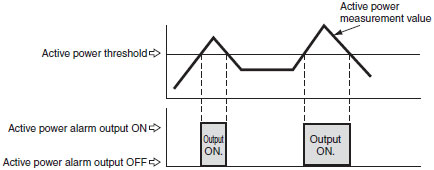
Alarm Output
An alarm can be output when active power exceeds a certain limit. There are two outputs; a pulse output and an output for alarm selection.
Alarms can also be set up for generated power (regenerative power), current, voltage, power factor, or reactive power to assist plant monitoring.

Built-in Logging Function
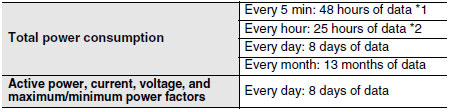
The total power consumption can be saved in internal memory every 5 minutes, hour, day, or month.
Data can be saved as follows: 5-minute data for two days, 1-hour data for eight days, 1-day data for month, and 1-month data for one year.
Data Logging Cycle and Amounts

Readout is not possible with key operations on the Power Monitor.
*2. Up to 48 hours of data can be read out using communications.
Functions That Support Installation and Settings
Direct Measurement of Three-phase, Four-wire, 400-V Line Voltage
Measurement is possible for single-phase two-wire, single-phase three-wire, three-phase three-wire, and three-phase four-wire power.
You can directly measure the voltage of a three-phase, three-wire 400-V line.
Simple Measurement
- The simple measurement function calculates the power from a fixed voltage and the measured current using a fixed power factor.
- This function can be used when the voltage cannot be input to the KM50 due to onsite conditions or wiring arrangements.
- If the Simple Measurement parameter is set to ON, the fixed voltage and fixed power factor can be set.
- The simple measurement function can be used to get an approximate power consumption of an installed circuit without wiring and measuring the voltage. Therefore, you must set the voltage and power factors to appropriate levels.
- Fixed values are used for the voltage and power factor, so the accuracy specifications do not apply.
Incorrect Wiring Detection
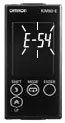
Incorrect voltage wiring can be detected.
If any mistakes were made during installation, they are automatically detected, reducing the time required for checking after installation.
This also reduces the risk of having to restart when a mistake is found.
Display for Faulty Wiring

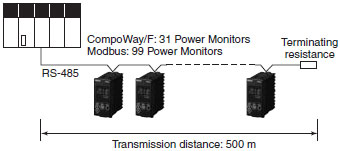
Communications
Up to 99 KM50 Power Monitors can be connected using RS-485 Modbus.
The energy use of each device can be managed with minimal wiring.

Tags: KM50-E