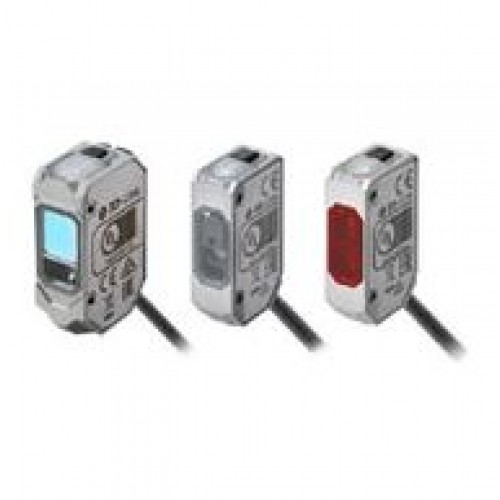
When difficult-to-detect workpieces (curved, glossy, or casting surfaces) cannot be detected correctly, sensors need to be reselected or adjusted. The E3AS Series provides reliable detection with less effect of curved, glossy, or casting surfaces, reducing design and commissioning time.
Automotive Industry
Reliable detection of difficult workpieces reduces equipment design and commissioning time
E3AS-HL for workpieces with curved or irregular surfaces and glossy workpieces
Reliable detection of metal workpieces with curved or irregular surfaces
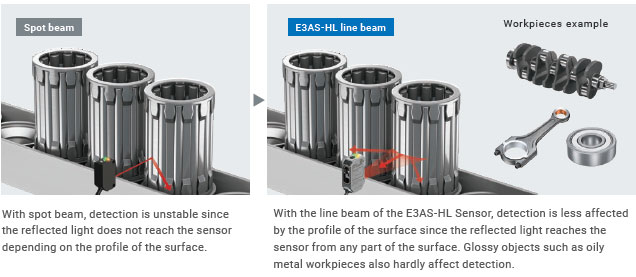
Reliable detection of various colored or glossy workpieces
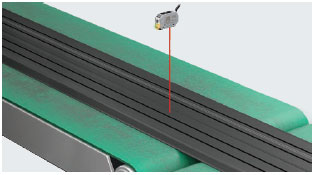
Level differences between low-reflective thin workpieces and the background sometimes cannot be detected. E3AS-HL Sensors, hardly affected by material type or color, can detect level differences.
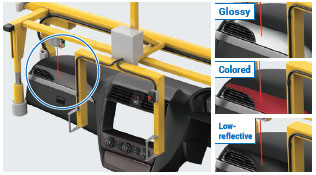
Detection is prone to be unstable because the sensing distance varies depending on the workpiece material and color. E3AS-HL Sensors, hardly affected by material type or color, requires no adjustment for each workpiece.
CMOS sensing with built-in lens alignment technology minimizes the influence of material properties [PATENT PENDING]*1
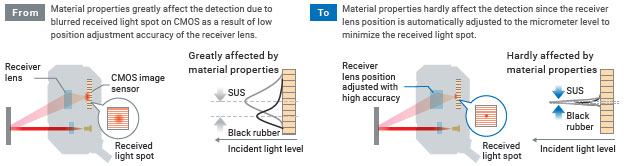
*1. “PATENT PENDING” means that we applied for a patent in Japan. (As of December 2021)
E3AS-F for large workpieces with various colors or rough surfaces
Reliable detection of metal workpieces with rough surfaces
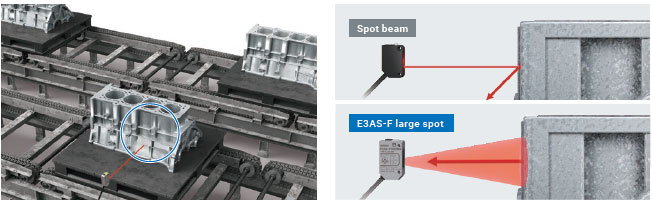
With spot beam, detection is unstable since the reflected light does not reach the sensor depending on the profile of the workpiece surface. With the large spot of the E3AS-F Sensor, detection is less affected by the surface roughness since the reflected light reaches the sensor.
Reliable detection of workpieces in various colors
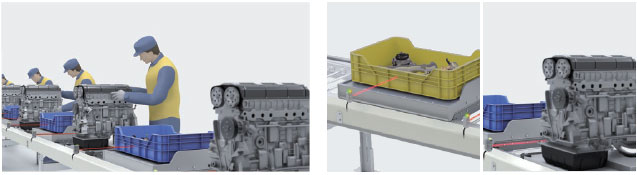
Detection is prone to be unstable because. the sensing distance varies depending on the workpiece color. E3AS-F Sensors using the TOF technology is less likely to be affected by changes in color, providing stable detection for different colored containers or engine blocks without changing the set distance.
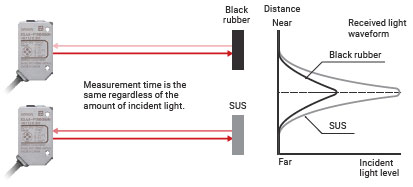
TOF detects varying workpieces and measures distance
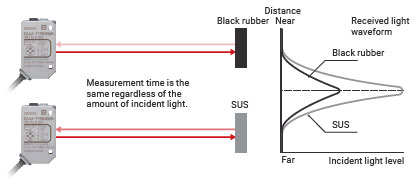
In the TOF (Time of Flight) method, the distance is measured based on the elapsed time instead of the amount of incident light received. Measurements therefore are not affected by changes in the color or material of the workpiece.
This means that low-reflective workpieces, such as black rubber, can be detected from the same set distances.
Flexible installation saves design time
Sensor space limitations make equipment design and retrofit work complicated, resulting in time-consuming work. The E3AS Series can be installed in challenging locations, which reduces design and commissioning time.
E3AS-HL for inclined and close mounting
Install regardless of workpiece shape and angle
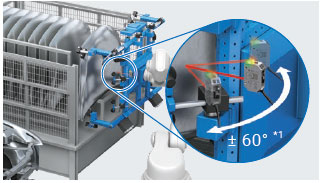
Curved surfaces of metal workpieces tend to affect detection, and it is time consuming to design the mounting angle. E3AS-HL Sensors can be mounted at a wide angle, making setup easy.
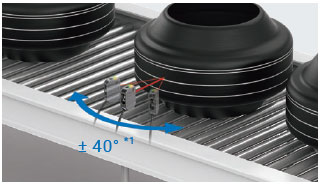
Curved surfaces of low-reflective workpieces tend to affect detection, and it is time consuming to design the mounting angle. E3AS-HL Sensors can be mounted at a wide angle, making setup easy.
Install in confined spaces or near lights
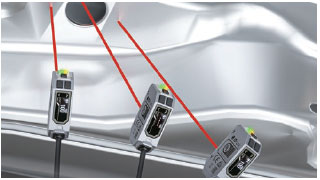
Interference with other sensors must be considered during design. E3AS-HL Sensors prevent mutual interference between up to 4 sensors, allowing close installation for applications like item identification from hole positions.
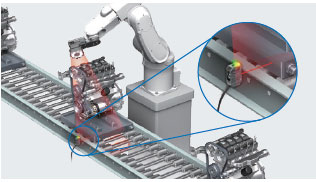
Effects of lights for cameras and sunlight must be considered during design. E3AS-HL Sensors can be operated under ambient illumination of 20,000 lx, which reaches the best in class level *2. This allows you to install the sensors in the vicinity of lights.
Sensing algorithm detects minimal reflected light from curved surface [Industry First]*2 [PATENTED]*3
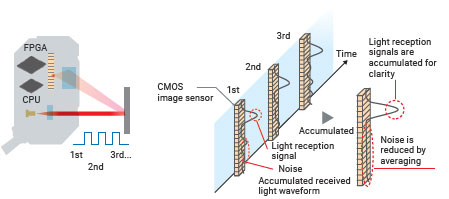
The E3AS-HL Sensor is the industry-first laser Class 1 CMOS laser sensor that comes equipped with an FPGA.
It performs high-speed sampling of received light waveforms at 10,000 times per second and OMRON’s unique accumulation processing, significantly increasing its sensitivity. It amplifies the slightest amount of light to reliably detect workpieces with glossy surfaces, complex shaped workpieces, black rubber, or other workpieces from which it is difficult to receive reflected light.
E3AS-F for long-distance sensing
Install reflective sensors instead of through-beam sensors
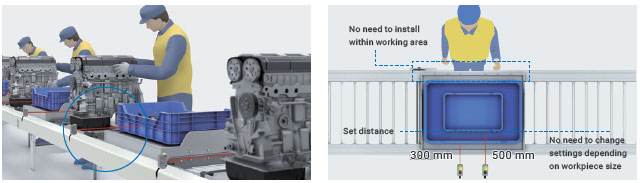
Reflective E3AS-F Sensors for long-distance sensing can be installed outside the working area, which is difficult with through-beam sensors. They use the TOF method to detect workpieces only and ignore workers.
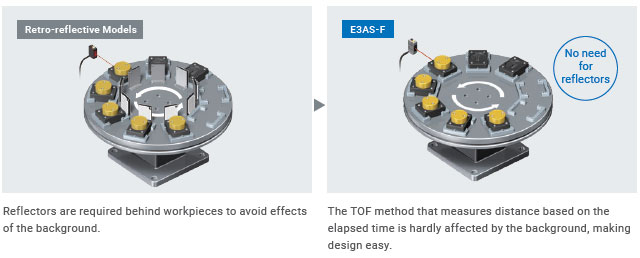
Installation almost unaffected by background
More flexible mounting with flexible mounting bracket [PATENT PENDING]*3
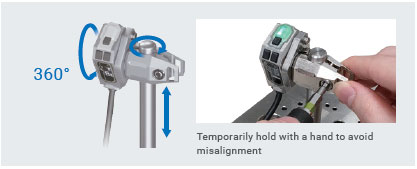
Optical axis can be easily adjusted in three directions: vertical, horizontal, and angular. This bracket can be mounted to any photoelectric sensor with a 25.4 mm mounting hole pitch as well as the E3AS Sensors.
No special safety measures required for Class 1 laser
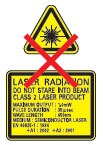
The E3AS Series is classified as Class 1, so laser safety measures are not required.
*1. The reference values were measured using the OMRON standard sensing object.
*2. Based on OMRON investigation in September 2019.
*3. “PATENT PENDING” means that we applied for a patent in Japan, and “PATENTED” means that we obtained a patent in Japan. (As of December 2021)
Antifouling coating on sensing surface ensures stable operation even in harsh environments
When a sensor malfunction or breakage due to the environment causes a line stoppage during mass production, it can take a long time to restart. With the protected sensing surface, the E3AS Series helps minimize line downtime and maximize uptime.
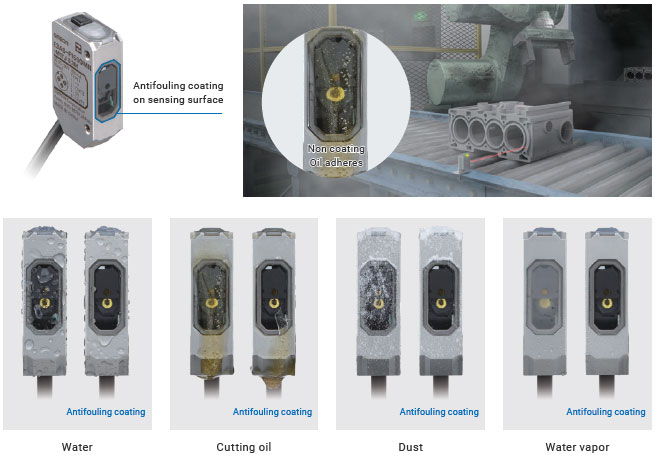
Antifouling coating on sensing surface reduces false detection and cleaning frequency [Industry First]*1 [PATENT PENDING]*2
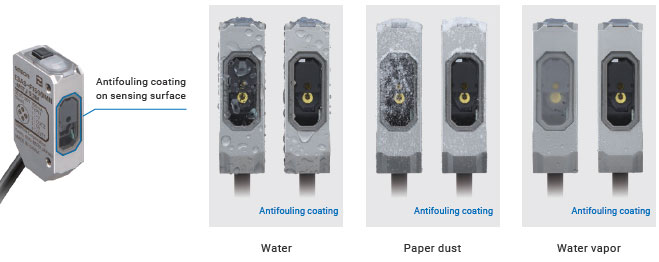
A dirty sensing surface can cause false detection due to the principle of photoelectric sensors. The E3AS Series has an industry-first antifouling coating on the sensing surface which prevents oil mist and dust from sticking to the sensing surface and keeps the lens from fogging as well. This reduces false detection and sensing surface cleaning frequency.
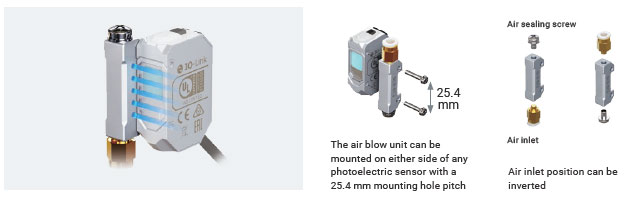
Air blow unit enhances the effectiveness of antifouling coating [PATENTED]*2
Using an air blow unit greatly reduces the frequency of false detections since it prevents the sensing surface of sensors installed in confined, difficult to clean locations from becoming contaminated. It can be mounted to any photoelectric sensor with a 25.4 mm mounting hole pitch as well as the E3AS Sensors.
Front protection cover reduces sensor failures
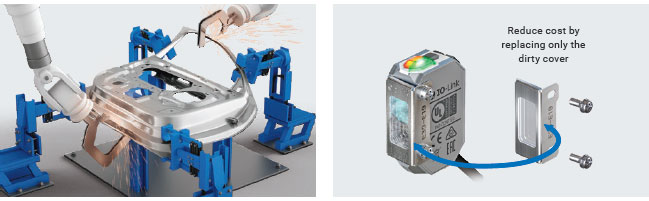
Welding spatter on the sensing surface or collision during operation can cause a sensor failure, and the sensor sometimes need to be replaced. Mounting the front protection cover prevents sensor failures. When any problems occur with the front protection cover, just replace it. There is no need to replace the sensor and rewire it.
Unique case design reduces the frequency of replacements caused by failure
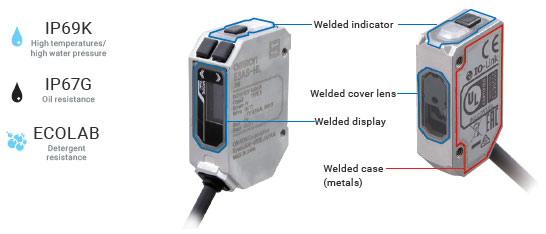
The sensor case is made of stainless steel (SUS316L). OMRON’s unique laser welding technology for different materials enhances the sealing and adhesion between the stainless steel and resin. The laser welding technology for metals are used to weld the case and cover of the E3AS-F Sensor for secure sealing and adhesion between the stainless steel.
Laser welding technology for different materials [PATENTED]*2
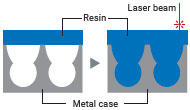
It is a technology to weld different materials, resin and metal, using laser beams. Tiny holes are bored into the metal case, then the resin part is melted in by a laser for secure sealing and adhesion.
Laser welding technology for different materials [TOF E3AS-F]
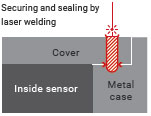
The metal case and cover are welded by a laser beam to seal the gaps. This ensures higher airtightness compared to adhesives, keeping out water and oil to reduce failures.
*1. Based on OMRON investigation in September 2019.
*2. “PATENT PENDING” means that we applied for a patent in Japan, and “PATENTED” means that we obtained a patent in
Japan. (As of December 2021)
*2. “PATENT PENDING” means that we applied for a patent in Japan, and “PATENTED” means that we obtained a patent in
Japan. (As of December 2021)
OLED display and teaching enable easy, quick, and optimal setting
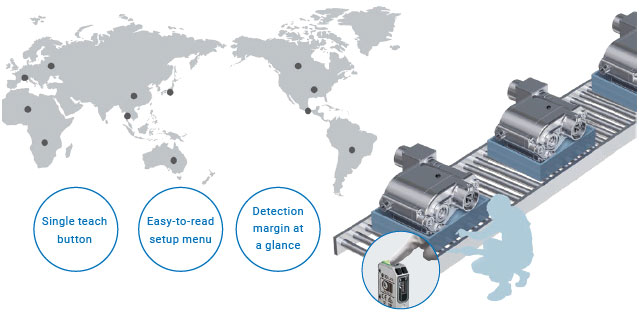
E3AS Sensors allow virtually anyone to set optimal settings on the easy-to-read OLED display using the teaching method. Moreover, easy-to-standardize operability makes remote instructions simple.
Easy-to-read, easy-to-understand OLED display [CMOS E3AS-HL]
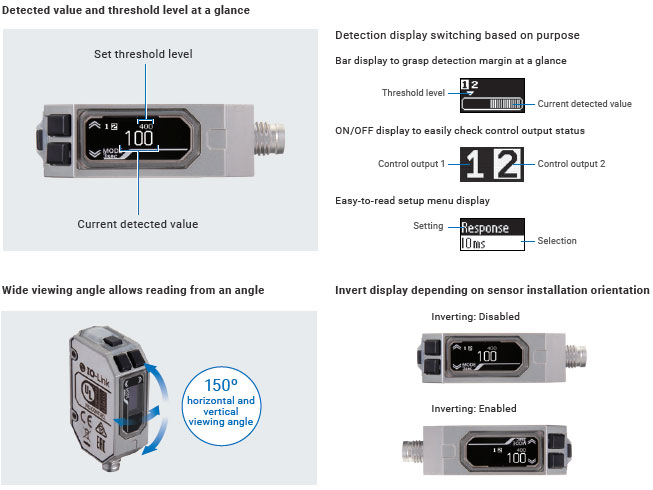
Displaying the threshold level and detected value on the same screen makes threshold level setting easy. In addition, wide viewing angle and display inverting allow on-site workers to easily see the display.
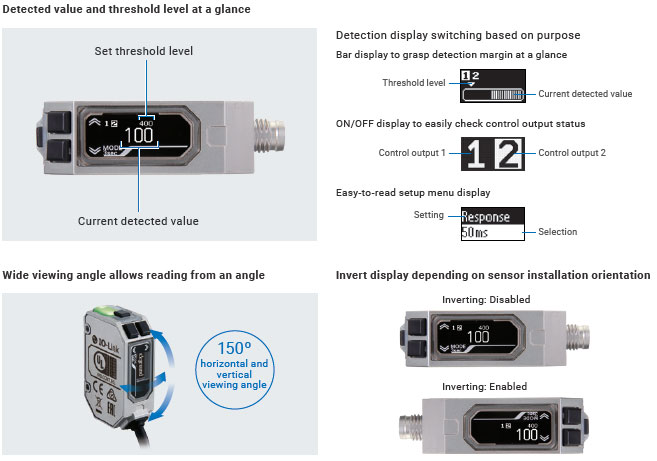
Single teach button prevents inconsistent settings
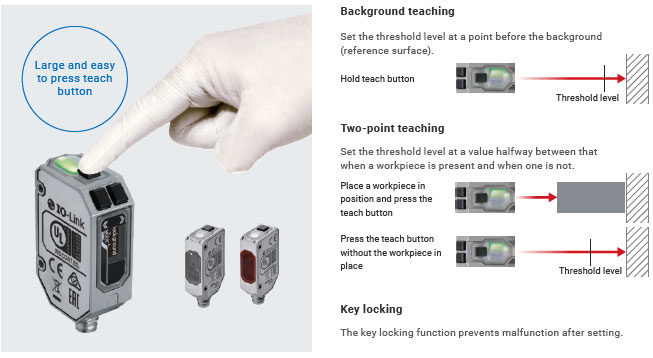
Easily and consistently set the optimal threshold level using the teach button.
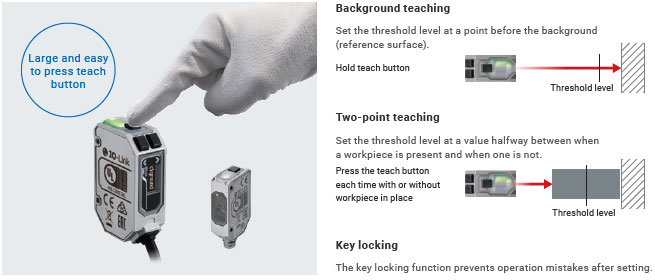
Object teaching for easy setting to detect workpieces within specified range [CMOS E3AS-HL]
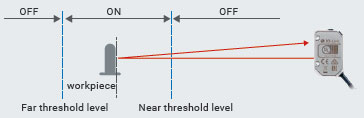
Object teaching allows you to easily set upper and lower threshold levels just by holding the button. This teaching is ideal for presence detection of workpieces without the background or within the specified distance range.
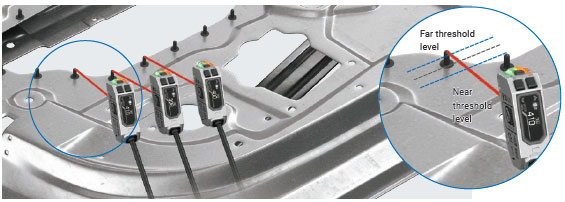
Just hold the button to set the threshold levels on the near and far sides of the workpiece position (reference position) at the same time. This teaching is used for presence detection of workpieces in the predetermined position.
Easy-to-standardize operations reduce commissioning time
When manufactures set up local production lines, the setup of sensors sometimes requires the experience and finesse of skilled workers and on-site instruction. The teaching method common to the E3AS Series enables you to standardize the operation procedures, facilitating remote instruction easier.
Line commissioning and maintenance with less people in less time with IO-Link
With IO-Link, reduce commissioning time by batch-setting the sensors and cut troubleshooting time during mass production by utilizing field data.
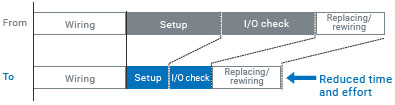
Reduce commissioning time by batch-writing settings from IO-Link device configuration tool
Setting information can be batch-written to thousands of sensors on a line, effectively reducing commissioning time and inconsistent settings.
Predictive monitoring and quick recovery by checking and monitoring sensor data
The monitor shows light intensity decrease due to sensing surface contamination or other reason, allowing users to take proactive actions to prevent potential false detections. This reduces the frequency of unexpected failures.
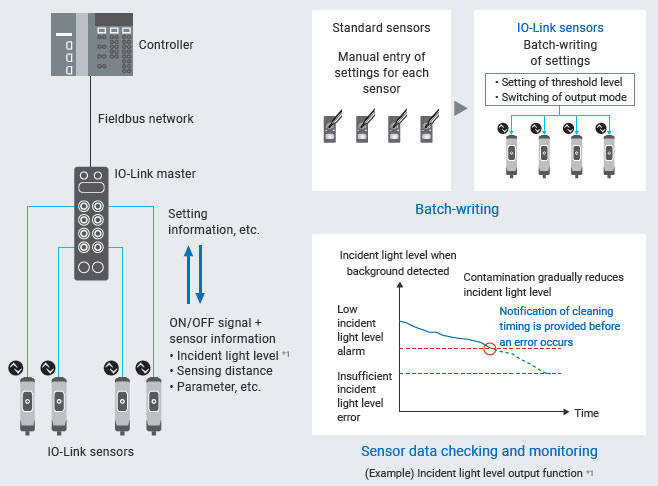
*1. E3AS-HL and E3AS-F only
Food and Commodity Industry
Stable detection for variable workpieces eliminates the need for redesign
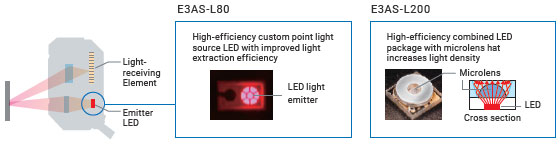
Conventional sensors have to be selected each time the shape, color, pattern, or reflectivity of the workpiece changes, so the equipment sometimes need to be redesigned. The E3AS Series can detect workpieces without being significantly affected by variable shapes, colors, and materials, saving redesign time.
E3AS-HL for complex-shaped, colored, patterned, or glossy workpieces
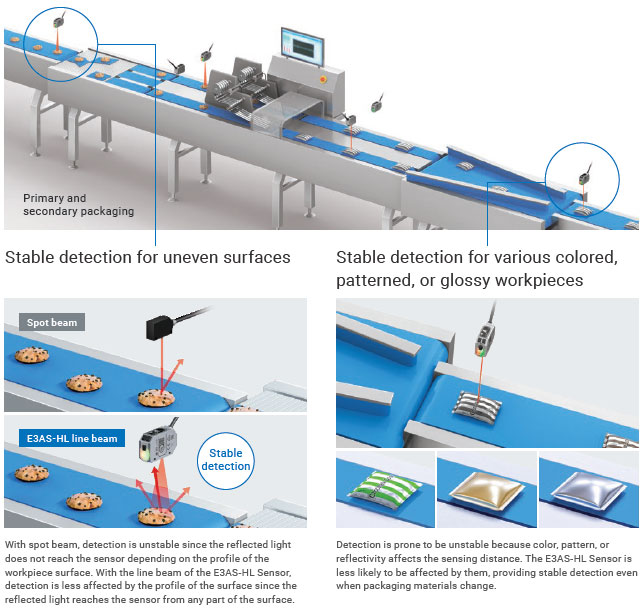
CMOS sensing with built-in lens alignment technology minimizes the influence of material properties [PATENT PENDING]*1
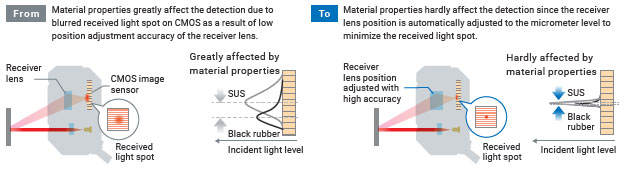
*1. “Patent pending” means that we applied for a patent in Japan. (As of December 2021)
E3AS-L for simple-shaped, low-reflective workpieces
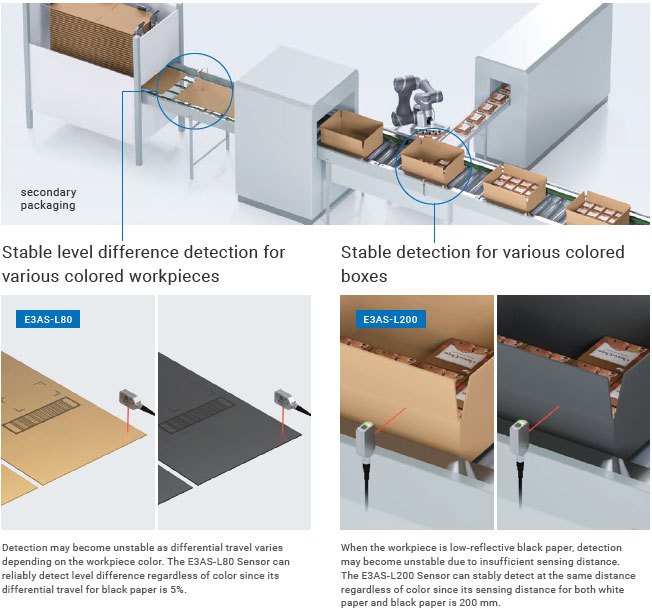
OMRON’s unique LED package stably detects low-reflective workpieces
The E3AS-L Sensor is equipped with an emitter 6 times more powerful than those of conventional models *2, and delivers stable detection due to its ability of receiving light reflected by low-reflective workpieces.
*2. Comparison with E3Z-LS products.
Overcomes space limitations, increasing design flexibility
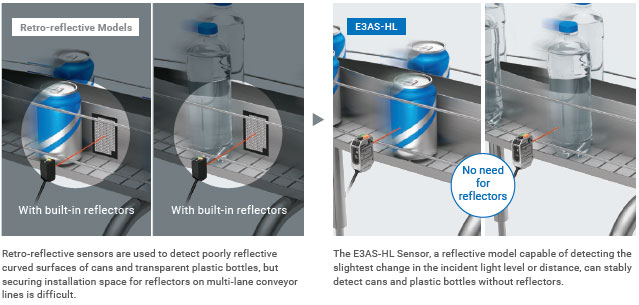
Retro-reflective sensors are used to detect difficult workpieces or where long sensing distance is needed. Designing with retro-reflective sensors is time consuming due to installation space constraints as the equipment gets sophisticated and complex. On the other hand, the E3AS Series allows for designing without reflectors.
E3AS-HL for multi-lane conveyor lines of workpieces with curved surface
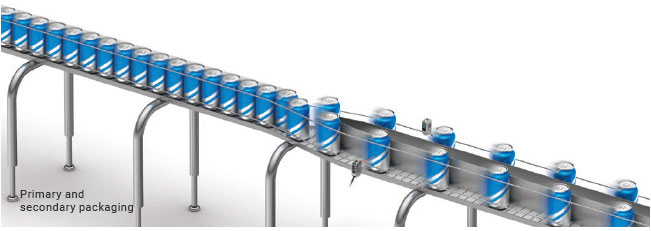
Stably detects cans and plastic bottles without reflectors
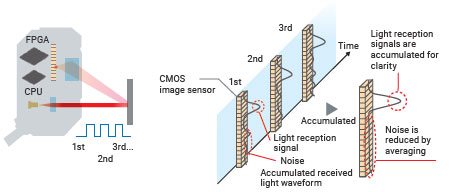
Sensing algorithm detects minimal reflected light from curved surface [Industry First]*1 [PATENTED]*2
E3AS-HL Sensors equipped with FPGA use the industry-first sensing algorithm to perform high-speed sampling of received light waveforms at 10,000 times per second and OMRON’s unique accumulation processing, significantly increasing its sensitivity. They amplify the slightest amount of light to stably detect workpieces with glossy or uneven surfaces, complex shaped workpieces, or other workpieces from which it is difficult to receive reflected light.
Note: Not applicable to transparent objects.
*1. Based on OMRON investigation in September 2019.
*2. “PATENTED” means that we obtained a patent in Japan. (As of December 2021)
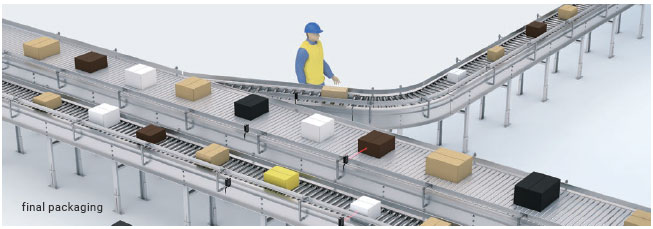
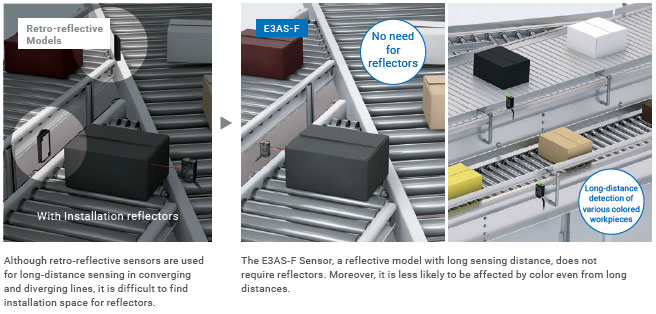
E3AS-F for long-distance sensing on converging and diverging lines
No reflector is required to design long-distance sensing unaffected by color or material of workpieces
TOF detects varying workpieces and measures distance
In the TOF (Time of Flight) method, the distance is measured based on the elapsed time instead of the amount of incident light received. Measurements therefore are not affected by changes in the color or material of the workpiece. This means that low-reflective workpieces, such as black rubber, can be detected from longer distances.
Teaching enables easy, quick, and optimal setting
E3AS Sensors allow virtually anyone to easily set optimal settings using the teaching method, eliminating rework due to problems during commissioning. Moreover, easy-to-standardize operability makes remote work instructions simple.
Single teach button prevents inconsistent settings
Easily and consistently set the optimal threshold level using the teach button
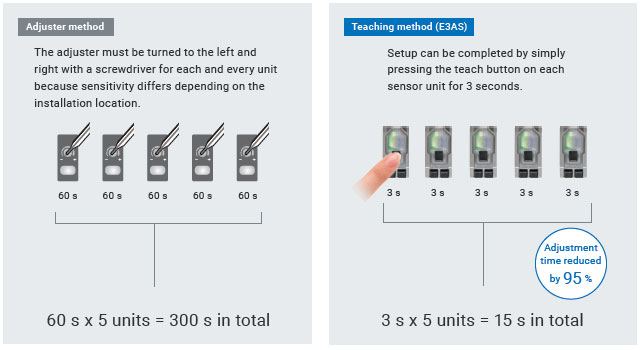
Fast and easy setup also when setting a large number of sensors
Sensitivity adjustment using the conventional adjuster method requires experience, finesse as well as time since the threshold level must be adjusted one unit at a time.
With the E3AS Series, just press the teach button to automatically set the threshold level, enabling fast and easy setting.
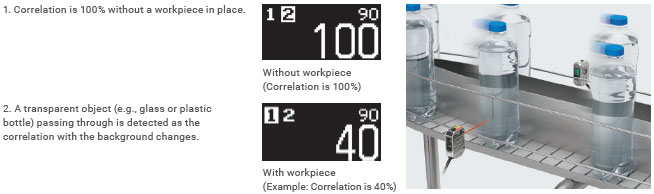
Background Reference Teaching (sensitive) for easy setup of transparent object detection [PATENT PENDING]*1 [CMOS E3AS-HL]
Previously, the setup of sensors for transparent objects required the experience and finesse of skilled workers, but it can now be done with just the press of a button. The E3AS-HL Sensor detects presence of workpieces from the variation (correlation) of background distance information and incident light level information.
*1. “Patent pending” means that we applied for a patent in Japan. (As of December 2021)
Easy-to-read, easy-to-understand OLED display [CMOS E3AS-HL]
Threshold level and detected value display on the same screen makes threshold level setting easy. Moreover, wide viewing angle and display inverting allow on-site workers to easily see the display.
Enhanced environmental resistance reduces line downtime and maintenance frequency
When a sensor malfunction due to the environment causes a line stoppage during mass production, it can take a long time to restart. With enhanced environmental resistance, the E3AS Series will be realized minimize line downtime and maximize uptime.
Antifouling coating on sensing surface reduces false detection and cleaning frequency [Industry First]*1 [PATENT PENDING]*2
A dirty sensing surface can cause false detection due to the principle of photoelectric sensors. The E3AS Series has an industry-first antifouling coating on the sensing surface which prevents water droplets and paper dust from sticking to the sensing surface and keeps the lens from fogging as well. This reduces false detections.
Tags: E3AS Series